Sermons / Sermon Discussion | 1st Corinthians: Part 22 - 1 Corinthians 14:1-25
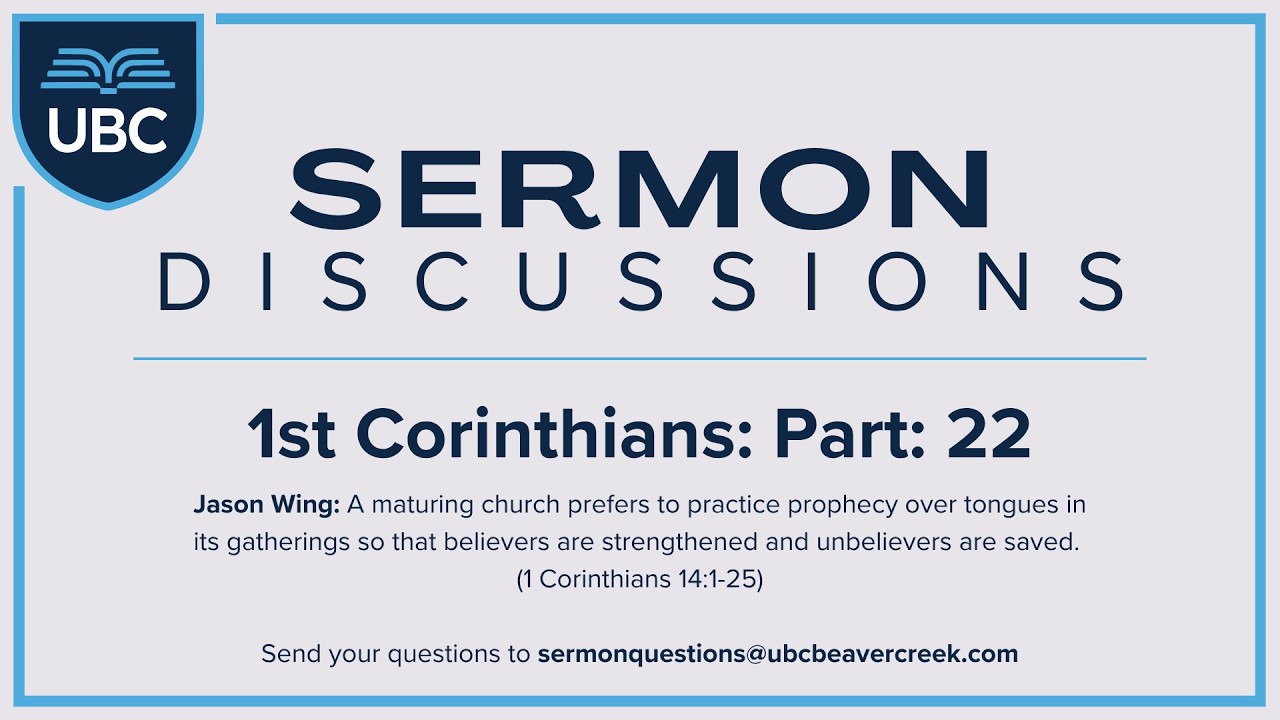
Sermon Discussion | 1st Corinthians: Part 22 - 1 Corinthians 14:1-25
Scripture Reference: 1 Corinthians 14:1-25
Main Idea: A maturing church prefers to practice prophecy over tongues in its gatherings so that believers are strengthened and unbelievers are saved
Questions to Consider:
- Does the way we worship help outsiders see that God is really among us?
- Are you eagerly desiring all that the Holy Spirit has for us, including the proper use of tongues and prophecy?
QUESTIONS:
1. Can you also explain your definition of speaking tongues more? Your definition very clearly indicates only human languages, but then you talk about praying in the spirit in a "language" only God can understand.
2. When it comes to speaking with tongues in church it would be orderly to have someone give the interpretation (v. 13, 19). However when a person speaks in tongues privately, as in vs 2, 4, 5, it is not necessarily the same and may not require any interpretation. Am I getting this correct?
3. Why would a preacher (or speaker) speak in tongues not known to the audience, even with an interpreter? Who can verify the interpreter’s message to be true?
4. When Paul says, “I will pray with my spirit, but I will pray with my mind also” in 1 Corinthians 14:15, what exactly does he mean by praying “with my spirit”? How do we know we aren’t reading our modern understanding of things like a private prayer language back into the text, especially when Paul refers back to Isaiah 28 and puts so much emphasis on understanding and building up the church?
5. I need clarity on how a special language even possibly be considered praying to the Lord… my understanding of prayer is it communicating with our Lord and Savior and is relational. If a person is uttering sounds and they don’t know what it means how is that really praying?
6. Is the private prayer language you affirm for some believers a known language or not?
7. A friend of mine prays privately in tongues, citing Rom 8:26 as one of their reasons. Is there any “harm” in practicing this, especially since they say it strengthens their faith? Or, is this an anti-biblical view of tongues that we should lovingly discourage, if the gifts are intended for the building up of the body, and furthermore seeing there’s no interpreter present?
8. Do you believe that speaking in tongues is a spiritual gift we should all desire to receive? The idea of speaking in tongues feels uncomfortable to me and not like a spiritual gift I desire to receive. Does this mean I am not fully open to how the holy spirit may want to work in my life?
9. Since the Bible talks about angelic tongues, is there also a demonic tongue/language? Or would this be better understood as Satan using uninterpreted tongues to cause disorder and confusion?
10. I have been in a worship service before in a predominantly English-speaking community but, as a show of solidarity, worship was performed in Spanish (which I don’t speak). There was no translation provided and I was left wondering, how can I join in worship when I don’t know what’s being said. I imagine others in the service were in the same situation as me. Does this passage have any bearing on this experience?
11. How can Prophecy be spontaneous when it requires testing?
12. How do we test prophecies?
13. I get that prophecy needs to be tested. But, if prophecy comes from the Holy Spirit and the Holy Spirit will not contradict the word, then why how is it possible to have a fallible prophecy?
14. Why is prophecy better in a small group setting if Corinthians seems to have them in the gathered assembly?
15. I absolutely think we should feel the Holy Spirit and that worship should affect us emotionally, but how do we know when we are genuinely experiencing the Spirit versus allowing our feelings or experiences to determine what we think the Spirit is doing?
16. We had a couple people ask about the same topic, so we will combine their questions here. Person 1 asks - How will we work to answer Jason’s second application question as a church? Do elders have ideas about how we can embrace both Word and Spirit as a gathered assembly? Person 2 asks - If the church is to desire the gift of prophecy, and if one feels they have the gift, how is UBC training/building people up in the skills required to use the gift well? Or even, how are we encouraging our members to practice their gift of prophecy? If this is something that ought to be developed in private, how should one do that?
17. How do we earnestly desire spiritual gifts? Should we pray for more or focus on what we think we have?
18. In light of your sermon today, why do you think UBC Beavercreek and other churches in kind don’t exercise the spiritual gifts of prophecy and speaking in tongues?
Thank you for listening and sending in your questions. As a reminder you can send your questions to SermonQuestions@ubcbeavercreek.com.
Watch / Listen on 📺 YouTube